
Evidence-linked credit analysis
Turn financial documents into review-ready assessments — with evidence behind every finding.
Two workflows on one engine: borrower assessment for loan advisors and lender credit teams, and corporate research for credit analysts. Documents go in; you get findings, schedules and a review pack — and any figure can be checked against its source in one click.
Both demos open immediately — no signup, no email. The borrower demo uses synthetic documents; the corporate demo is built from 15 public documents.
Products
One evidence engine, two workflows
Borrower Assessment Pilot
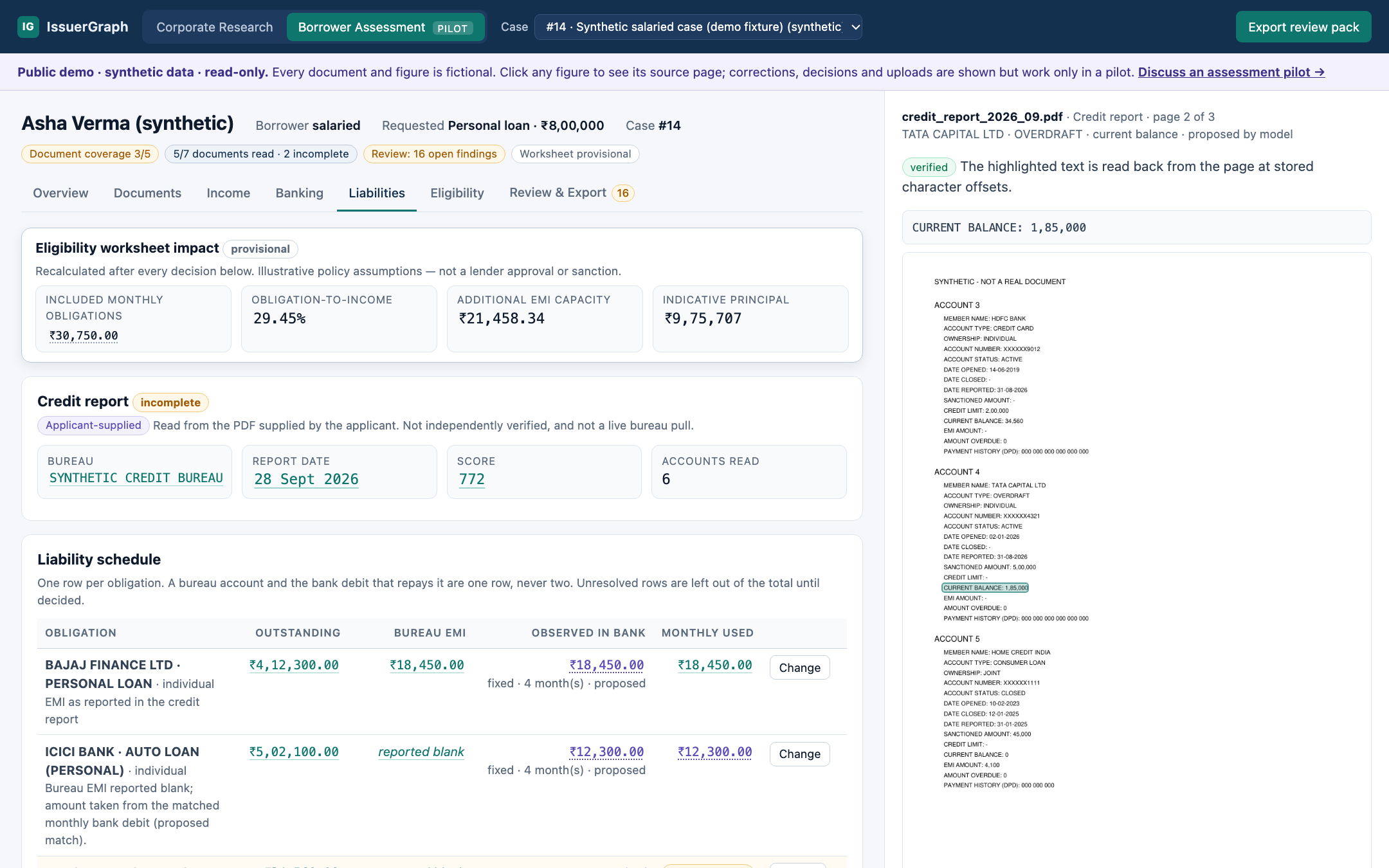
For loan advisors, DSAs and lender credit teams. Bank statements, salary slips, Form 16, the applicant's credit report and business registrations become an income review, a liability schedule, banking analysis and an illustrative eligibility worksheet.
Illustrative worksheets only — never a lender approval, a risk score or an approval probability.
Corporate Research Available
For credit research and private-credit teams. An issuer's debt, rated instruments and rating actions across its annual report and agency rationales, with disagreements between sources shown side by side and dated.
The public sample covers one issuer from 15 public documents.
Borrower Assessment in three steps
Provide documents
Statements, slips, the credit report, Form 16 or ITR, GST and Udyam certificates. Each is recognised from its content, whatever the file is called.
Review the findings
Missing information, possible discrepancies and items to confirm, each with its control. A loan and the bank debit that repays it count once; an overdraft limit is never treated as debt.
Export the review pack
An Excel workbook of exactly what is on screen: schedules, findings and their status, assumptions with their basis, and the source of every figure.
Works today
- Salaried borrowers: slips, Form 16, statements, the applicant's credit report, liability schedule and worksheet
- Proprietorship (early): GST and Udyam vintage, current-account banking analysis, document checklist
- Digital statements in HDFC-style and ICICI layouts, reconciled row by row
- Analyst corrections and decisions with reasons; Excel review pack
Through a scoped pilot
- Your most frequent banks' layouts and scanned documents
- Reading ITR computations and financial statements; GST returns; turnover consistency across GST, ITR and bank
- Partnership and company borrowers; your lenders' checklists and your MIS format
- A private hosted workspace with sign-in for your team
How you verify
Three kinds of number, each checkable
Read from a document
Click it and the page it came from opens, with the text highlighted. If a value could not be found on the page, it is marked unverified and kept out of the totals.
Calculated
Click it and you see the working: the figures or transactions it was computed from, each of which opens its own source.
Entered by an analyst
Corrections, decisions and assumptions are recorded with their reason and basis, alongside the original reading — nothing is silently overwritten.
Built for people who have to show their working
If a figure has to survive a lender's credit desk or an investment committee, "the system says so" is not enough. IssuerGraph checks every value against its source before storing it, so the answer to "where did this come from?" is always one click away.
Loan advisors and DSAs
Assess a borrower's income, obligations and banking from their documents, and hand lenders a file they can check.
Lender credit teams
Review applicant-supplied documents with every finding traceable, and decisions recorded with their reasons.
Credit research
Surveillance across an issuer's disclosure and its rating agencies: has anything changed, and who says so.
Private credit and risk
Diligence where figures are spread across documents that do not agree, with a dated record of each difference.
Corporate Research workflow
Four things, each of which is checkable
Review facts
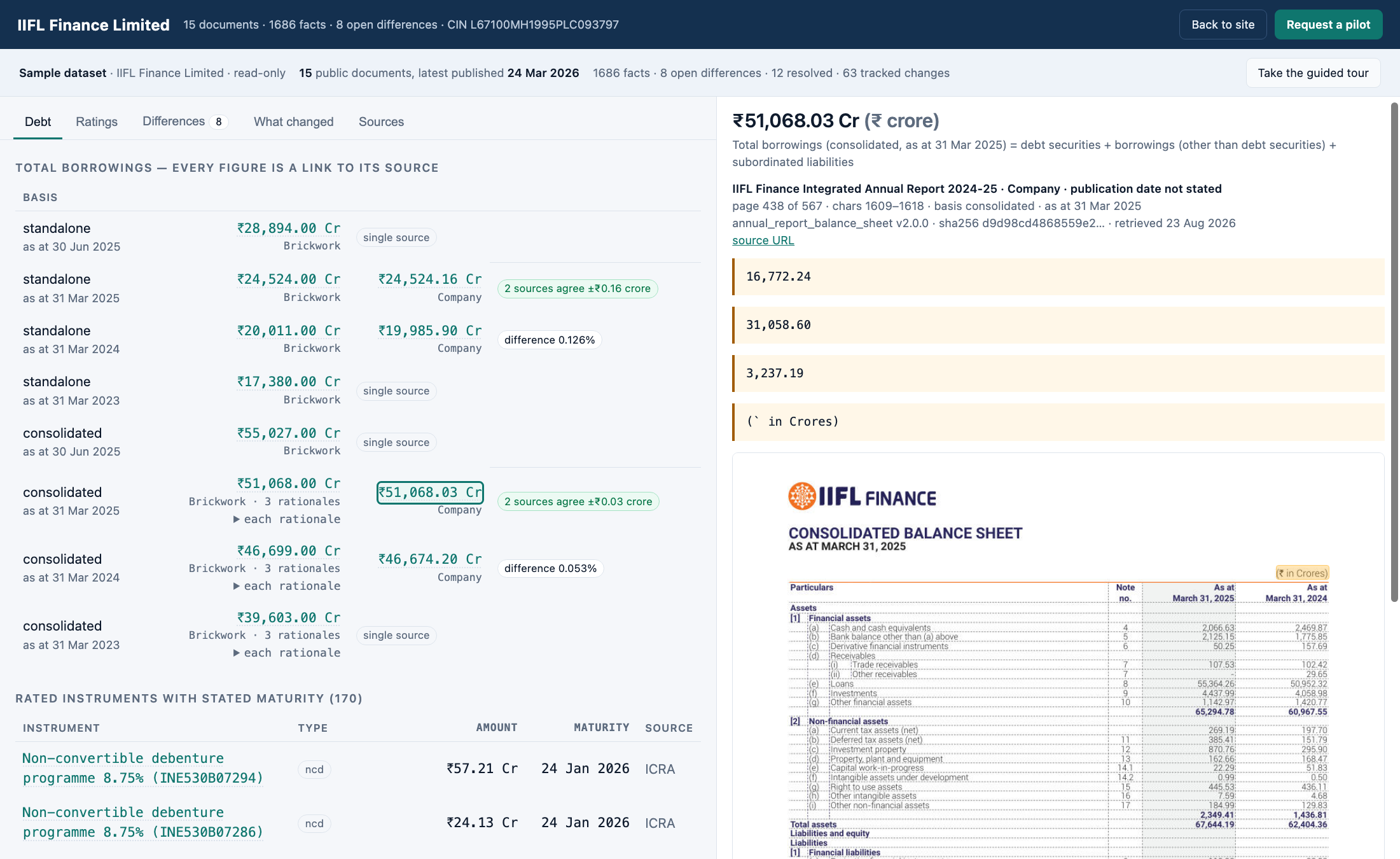
Total borrowings by basis and date, rated instruments with maturities, rating actions by agency. Derived figures state their arithmetic.
Inspect evidence
Click any figure to open the page it came from, with the exact characters highlighted — including the header that establishes the unit.
Compare sources
Where documents disagree, both values are shown with their own evidence, the tolerance that was applied, and the period both views were in force.
Track changes
Successive rationales from one agency, diffed structurally: what appeared, what went, what moved — both sides anchored to their own document.
Needs attention A difference between sources is not an error
Most differences are definitional. In the sample dataset, a rating agency's "Total Debt" exceeds the annual report's by ₹24.80 crore on one basis and ₹25.10 crore on another — almost certainly one definitional difference, not a mistake by either party. IssuerGraph flags it for an analyst to judge, records when it was first seen, and never silently picks one number.
Corporate Research — the actual product
Live excerpt from the sample issuer
Not a mockup: the rows below are rendered from the same snapshot the demo uses, through the same code. Counts come from the data.
Loading sample…
Corporate Research coverage
What Corporate Research reads today, stated plainly
This is an early system with a deliberately narrow scope. Being precise about the edges is more useful to you than a longer list would be.
What works now
- Indian NBFC annual reports — Ind AS balance sheets, consolidated and standalone.
- Rating rationales from ICRA, CARE, Brickwork and Crisil: rating tables, instrument annexures, rating-history annexures, liquidity sections, strengths and challenges.
- Crisil publishes its rationales as web pages whose terms restrict redistribution, so Crisil evidence is shown as a short quote with a link to Crisil's own page — which highlights the quoted text in supporting browsers — rather than as a page image.
- Debt figures, rated instruments and maturities, rating grade, outlook and watch.
- Cross-document comparison with two tolerances, and effective-dated rating comparison per instrument class.
- Every stored fact is checked against its source before it is stored.
What it does not do yet
- One issuer is loaded in the public sample. It is a vertical slice, not a universe.
- Five extractors, tuned to five publishers' current layouts — the annual report and four rating agencies. A new publisher needs a new extractor.
- Each extractor declares what its document must yield — balance-sheet rows, the rating table, liquidity, sensitivities — and a shortfall is recorded as incomplete with reasons rather than passed as complete.
- A rating is treated as in force until that agency acts again or withdraws it, with no staleness horizon — so a two-year-old action still counts as current.
- No score, no recommendation and no chat interface. Corporate Research reads public documents only; uploading your own documents is part of Borrower Assessment.
The sample dataset is fixed, with documents published up to 24 Mar 2026. It is not updated as new filings appear.
Paid pilot
Start with the workflow you need
A pilot is scoped work on your own cases or issuers, run over four weeks, ending with something your team can use or reject on evidence.
Borrower Assessment pilot
- You get: a private workspace for your team, tuned to the banks and documents you see most, with review packs in your format and a written account of what could not be read.
- We need: a sample of anonymised past cases, your document checklist, and an analyst who will check the output against their own work.
Corporate Research pilot
- You get: your issuers loaded from their own public documents, a differences report with evidence, a hosted workspace and the underlying data.
- We need: five to ten issuers, the documents you treat as authoritative, and one workflow to target — surveillance, diligence or a recurring report.
Pricing is scoped per pilot — it depends on how many new document layouts need work, which is the part that takes real effort. Tell us your workflow, and you will get a fixed price and a schedule rather than a quote range.
Questions
FAQ
Where do the facts come from?
Public documents, fetched over HTTP from the publisher's own URL: the issuer's annual report and the rating agencies' published rationales. Each document is stored with its SHA-256, its source URL and the time it was retrieved, all of which are shown in the demo under Sources.
Nothing is generated. If a figure is not printed in a document we hold, it does not appear — and a figure computed from several rows, like total borrowings, states its own arithmetic and carries one anchor per component.
How do I verify a number?
Click it. The panel shows the document, the page, the character range, the extractor and version that produced it, and the page image with those exact characters highlighted. The highlight is drawn from geometry recorded at extraction time, so it cannot land on a different occurrence of the same text on the page.
Crisil is the exception: its rationales are web pages whose terms restrict redistribution, so no copy is shown. You get a short quote, the same document details, and a link to Crisil's own page that asks your browser to highlight the quoted text. The full text is still verified before it is stored.
Before anything is stored, the loader re-reads the page and asserts that the quoted evidence equals the characters at those offsets. If it does not, the whole document fails to load rather than storing a fact it cannot prove.
What happens when two sources disagree?
Both are kept and shown together with their own evidence. Numbers are compared with two tolerances — a relative band and an absolute floor — because a percentage-only test treats the same rupee difference differently depending on the size of the number it sits on.
Ratings are compared only between agencies rating the same instrument class on the same rating scale, over periods that actually overlap. A difference records when it was first detected and whether it is still present; one that stops recurring is marked resolved rather than deleted.
What does Borrower Assessment read?
Today: digital bank statements (HDFC-style and ICICI layouts), salary slips, Form 16 Part B, ITR JSON, CIBIL report print-outs, and GST and Udyam certificates. Identity documents are recognised but not read. Other banks, scanned documents, ITR computations and financial statements are pilot scope. A document that cannot be read is shown as not read — never as an empty result.
Which issuers and documents are supported?
Today: Indian NBFC annual reports with Ind AS balance sheets, and rating rationales from ICRA, CARE, Brickwork and Crisil. The public sample is one issuer, IIFL Finance, across 15 documents.
A new publisher needs an extractor written for its layout — that is the honest unit of work in a pilot, and it is why scoping asks which documents you treat as authoritative.
What does onboarding involve?
You send a list of issuers and the documents you consider authoritative. We load them, write or adapt the extractors, and give you a workspace plus a written note on what could not be extracted and why. No integration, no data from your systems and no credentials are required to start — everything in the pilot comes from public documents.
What happens to what I submit?
The pilot form stores what you type so we can reply about a pilot. You are not added to a mailing list and no outreach sequence is triggered. Analytics, when enabled, records that a page was viewed or a form submitted — never your name, your email address, what you typed, or any document content. The details are in the privacy notice.
Who is behind this
Deo Shankar
Founder
Deo Shankar is the founder of IssuerGraph. He brings over 14 years of experience in cloud architecture and enterprise engineering, including work across banking and financial services. He is building IssuerGraph to help credit-research teams review issuer debt and rating changes, compare information across documents, and trace findings back to their original sources.
Questions, or something in the sample that looks wrong? A specific correction about a specific figure is the most useful thing you can send.